
‘Horticulture dares to think big in major energy challenge’
“Horticulture dares to think big in major energy challenge.” (2026, April 21). Greentech.
https://www.greentech.nl/news/horticulture-dares-to-think–big-in-major-energy-challenge
The energy market is under considerable pressure. Due to geopolitical tensions, the availability of gas and oil has decreased significantly, resulting in high prices. Moreover, entrepreneurs are increasingly being asked to do more when it comes to sustainable production. Not only does this offer opportunities for alternative energy sources, but growers are also being helped by various innovations to use energy more efficiently, such as the application of smart LED systems in the greenhouse and the use of a thermal battery.
At GreenTech, ‘PURE’ represents clarity and purpose in crop production. It’s about skilled professionals working with care and responsibility, applying well-considered methods within controlled environments that ensure consistency, transparency, and trust. We spotlight what truly drives innovation in horticulture. In the GreenTech monthly newsletter series, we’ll explore ‘PURE’ from multiple perspectives, bringing you fresh insights, trends, and technologies shaping the future of growing.
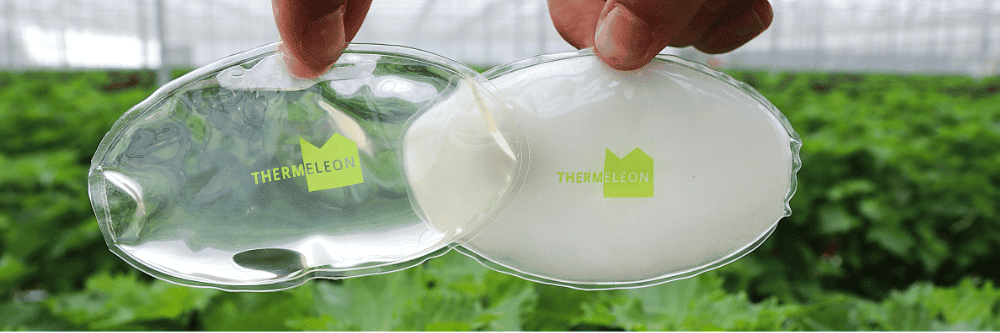
In recent years, numerous innovations have been developed to help growers reduce their energy consumption or adopt a different approach. For instance, Thermeleon was founded in 2020 based on a fundamentally different perspective on energy in the greenhouse. The sustainable Thermeleon Heat Battery transforms the greenhouse into an energy source. “While energy is often viewed as a problem, we see it differently: at Thermeleon, we view greenhouse energy not as a shortage, but as an abundance. Thanks to the greenhouse effect, a closed greenhouse in principle generates 3 to 5 times more heat than is actually needed over the course of the year. The challenge, therefore, lies not in production, but in timing: too warm during the day and too cold at night. That paradox – abundance yet shortages – formed the basis for Thermeleon,” says Director Jildou de Jong.
Storage of energy
With a strong technological foundation and collaboration with parties such as Wageningen University & Research, TNO, greenhouse builders, and the Dutch manufacturing industry, Thermeleon is developing a new energy system for greenhouses in which storage is central. “A greenhouse is essentially a huge solar collector. Due to the greenhouse effect, a surplus of heat is generated daily, even in winter. Yet that heat – along with CO₂ – is often lost through ventilation, while active heating is required again at night.”
Thermeleon developed the world’s first passive thermal battery for high-tech greenhouses. Its operation is based on phase-change material (PCM): during the day, the material melts and absorbs heat, cooling the greenhouse. At night, it solidifies and releases heat, heating the greenhouse. What makes the solution unique is that its operation is completely passive. No pumps or electricity are used, and no maintenance is required. Additionally, the battery is integrated directly into the greenhouse, and the system is scalable and modular. The result: 15–30% energy savings and a payback period of 2 to 4 years. An important milestone in the development of Thermeleon was the collaboration with Koppert Cress and DivisionQ, De Jong indicates. “Thanks to their willingness to test at scale and participate intensively in the evaluation, the technology could be further developed at an accelerated pace. As a result, we now have a validated product.”
Transition to fossil-free
De Jong sees that the energy challenge is significant. “But so is the sector, and it dares to think big. Greenhouse horticulture is one of the most high-tech sectors in the world. Every grower we have spoken to is highly technically skilled, curious, innovative, and solution-oriented, while simultaneously strongly focused on crop quality. It is precisely this combination that makes the sector unique. We believe that the Netherlands and the Dutch grower provide the ideal breeding ground to further scale up this promising new technology.” The ambition is clear, according to De Jong: “To transform the greenhouse from an energy consumer into an energy source, thereby making growers more profitable, stabilizing the climate, and accelerating the sector’s transition to fossil-free.”
Signify, the market leader in advanced lighting systems, also observes that global energy prices are having an increasing impact on business operations. “Recently, structural extreme peaks in gas and electricity prices have emerged, partly due to the situation in the Middle East. This presents growers with challenges. As a result, efficiency and operational costs suddenly become much more important. As a grower, you will need to adopt a more flexible approach to better manage your energy and respond to real-time changes,” says Anne Jancic, Product Manager for Intelligent Lighting Solutions.
Handle light efficiently
Jancic sees that growers are investing in expanding or renewing their energy supply to enable more flexible production, consumption, storage, and feeding back into the grid. “Think of batteries and electric boilers. But also, smart lighting systems, with which they can respond to energy markets in real time.” According to Jancic, it is essential to handle light efficiently and intelligently. [JZ1.1]“A large portion of energy costs during the dark months relates to lighting. For example: for a Dutch tomato grower, about 30% of costs are now energy, a large part of which is for lighting. On the other hand, revenue from energy trading can now account for up to 30% of growers’ income. With intelligent lighting, crop lighting becomes a flexible energy asset. This enables growers to plan and trade their energy budget more strategically, deploy lighting more efficiently and flexibly, and at the same time remain plant-oriented, while maintaining the desired control and certainty.”
According to Jancic, lamp efficiency is the foundation, but there are more essential factors. Such as the response time and accuracy of your control system when participating in markets like imbalance or aFRR (Automatic Frequency Restoration Reserve). Or the ability to deploy the lights intelligently: are they dimmable or color-adjustable and suitable for supporting smart algorithms? “Finally, integration with other systems such as a climate computer and energy platform is necessary. The choice of your lighting system therefore depends on your business strategy; how central do you place your plant, and how flexible do you want to be regarding energy trading?”
Save energy and stimulate growth
Three essential elements are needed to get the most out of the lighting strategy, says Jancic: a multi-channel LED lamp, a control system for real-time management, and smart apps. “We recently introduced Philips GrowWise smart spectrum, an innovative algorithm that automatically optimizes LED lighting for horticulture based on current solar radiation. This enables growers to save energy or stimulate crop growth with just a few clicks, ushering in a new era of intelligent, data-driven lighting strategies. By replacing less efficient light spectra with more energy-efficient alternatives, GrowWise smart spectrum saves energy or stimulates crop growth by up to 6%.”
AI and smart algorithms can help growers make better and faster choices and automate lighting control, Jancic believes. “We strive to help growers with user-friendly, transparent solutions that take center stage with their business strategy and plants. This support focuses on balancing crop performance and energy consumption, so that growers do not have to choose between yield and efficiency. A good example of this is the Smart Spectrum algorithm: this ensures that spectrum changes never lead to unplanned shifts in the energy budget or light output. This guarantees that growers always stay within their energy budget or achieve the desired light output, regardless of the basic light recipe or intensity. In this way, we turn lighting into a smart, safe energy asset that enables every grower to optimally achieve their business goals.”
